Fig. 1 The bay horse, Daisy, at a gallop (Plate 526)
by Colin Harris
Continue reading “Eadweard Muybridge’s Animal Locomotion”exploring lists in all their possibilities

Fig. 1 The bay horse, Daisy, at a gallop (Plate 526)
by Colin Harris
Continue reading “Eadweard Muybridge’s Animal Locomotion”by Martha Rust
A survey of Listology posts shows that the list form is often used to convey advice or wisdom, and when it does, the list’s items are limited to a certain number, which is then featured in its title: the Ten Essentials for Hiking, for instance, or Seven Lessons from Mister Rogers. In this post, we consider an ancient list-based genre of literature that elaborates on this kind of advisory list. Famed German literary scholar Ernst Robert Curtius (1886-1956) placed this list-based genre in the category of wisdom literature and gave it the name Zahlenspruch, or “numbered saying,” which Willard R. Trask translated as “numerical apothegm.”[1] As our examples will show, whether or not a numerical apothegm conveys wisdom, it gives a reader much to think about.[2]
Continue reading ““There are three things…”: Introducing the Numerical Apothegm”
Oxford, Bodleian Library Digby MS 88, f. 97v
(© Bodleian Libraries, University of Oxford)
by Martha Rust
The photo above is of a page in Oxford, Bodleian Library Digby MS 88, a fifteenth-century collection of miscellaneous texts in English and Latin on astronomy, medicine, divination, and theology.[1] The short, untitled work occupying this particular page creates a curious first impression. Continue reading “A list on the work of things”
We at Listology recently had the pleasure of reading Katie Little’s list insights in her recent publication, “The Politics of Lists,” in the journal Exemplaria.[1] For those who have not yet had the pleasure of reading the article, Little uses medieval lists written in Chaucer’s “Knight’s Tale” and the Anglo-Saxon Chronicle (a historical record of England compiled before the eleventh century) to re-examine modern materiality theorists’ idea that lists are ideology-free because they blend human and non-human subjects. We at Listology would like to continue this conversation about lists’ ideological and political characteristics , and the article’s author, Katherine Little, has kindly obliged us by answering some of our questions—some of which readers will find answered more extensively in her article published by Exemplaria.
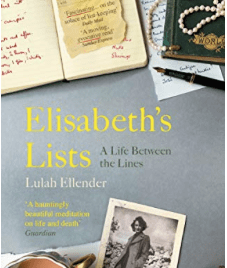
Lulah Ellender, author of Elisabeth’s Lists: A Life Between the Lines (Granta, 2018), met her grandmother through the lists she left behind. The book reconstructs from lists the life of Lulah’s grandmother Elisabeth, who died when Lulah’s mother was nine years old. Elisabeth started writing her curious book of lists after marrying a diplomat in the 1930s. These lists, which provide glimpses into Elisabeth’s life and mind, offer Lulah a starting point for exploring the life of a grandmother she never met. The following is a conversation between Lulah Ellender and the editors of Listology.
Continue reading “An interview with Lulah Ellender, author of Elisabeth’s Lists: A Life Between the Lines”by Martha Rust
Today is Labor Day in the United States, a holiday that celebrates laborers and the labor movement on the first Monday in September. As Wikipedia explains in a quotable list, Labor Day honors “the contributions that workers have made to the development, growth, endurance, strength, security, prosperity, productivity, laws, sustainability, persistence, structure, and well-being of the country.”[1] In addition to honoring work generally, Labor Day heralds the beginning of a new school year and the return of students and teachers to the labor of teaching and learning. While the American calendar thus pays tribute to labor annually, the western medieval calendar honored it monthly, observing a wider array of labors than its modern American counterpart. Continue reading “Two Lists of Labors in Honor of Labor Day”

by Kerstin Fest
In the theatre we encounter stories, first and foremost those written by playwrights and acted out on stage. But there are also stories produced behind and beyond the stage. Gaining awareness of these secondary stories and piecing them together helps one study and understand the theatre. Continue reading “The Story of Theatrical Lists”

by Martha Rust
To have read Kenneth Grahame’s The Wind and the Willows (1908) is to know and love the riverside community of Toad, Ratty the Water Rat, Mole, and Badger along with all of their wisdom, foibles, and delicate sensibilities. Continue reading “From Ecstasy to Enchantment: Two Lists in Kenneth Grahame’s The Wind in the Willows”

by Martha Rust
What comes to mind when you think of summer? Probably a whole list of things: long days, endless blue skies, beaches, travel, sandals, watermelon, and blackberry pie. That’s the list that first pops into my mind, but it could easily go on (and on): bicycling, canoeing, hiking, beautiful long sunsets– and broad vistas of all kinds. Continue reading “A Summer Classic”

