Weaving the Nation in the Feriby Counter-Roll and Medieval Romance

by Nick McKelvie

As I mentioned in my previous post, the final documented step of the textiles listed in the Feriby counter-roll (Kew, The National Archives, E 101/383/6) was their distribution to Edward III’s subjects; what I did not mention is that this gesture echoed a practice of the Great Khan of the Mongol Empire, who, according to Marco Polo, “gives rich clothing to [his] 12,000 barons and knights 13 times a year; he dresses them all in the same clothes— like his own, and very worthy.”

Continue reading “Weaving the Nation in the Feriby Counter-Roll and Medieval Romance”
Crowned with Cloth: A 1327 Counter-Roll Listing the Expenses of the Coronation of Edward III

by Nick McKelvie

The recent coronation of King Charles III has brought new attention to English coronation traditions, including the use of a “coronation roll” to document the details of the accession. The National Archives of the United Kingdom recently announced an exhibit, for example, titled “Happy & Glorious: Coronation Commissions from the Government Art Collection,” which displays the earliest coronation roll still in existence (produced for Edward II in 1308) paired with the recent coronation roll created for King Charles III.1 Edward II’s roll is only two feet long, whereas Charles III’s is twenty-one meters; more scandalously, while Charles III’s features Queen Camilla quite prominently, Edward II’s makes no mention of Queen Isabella, although it does reference Piers Gaveston, 1st Earl of Cornwall, who was rumored to be the king’s lover.

Continue reading “Crowned with Cloth: A 1327 Counter-Roll Listing the Expenses of the Coronation of Edward III”

All his Money, In a Word

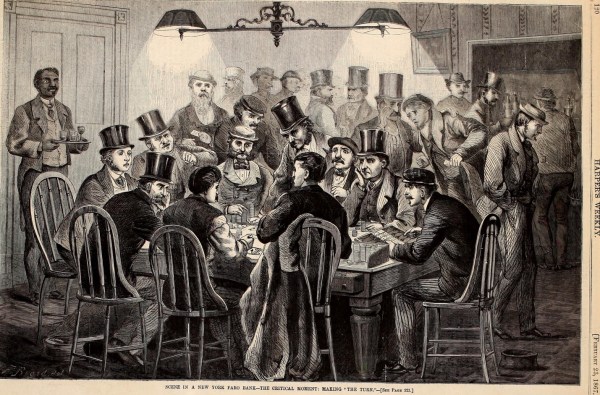
“Scene in a New York Faro Bank,” Harper’s Weekly, 23 February 1867: 120.

by Leslie Myrick

Charles Godfrey Leland, (1824-1903),[1] Philadelphia-born journalist, folklorist, translator of German poetry, and writer on the Romani and the occult, is best remembered as the creator of the humorous balladeer “Hans Breitmann,” who made his first appearance in “Hans Breitmann’s Barty” in the June 1857 issue of Graham’s Magazine. As a lexicographer of slang as a sub-category of folk language,[2] Leland was also a creator and a connoisseur of lists. This post will examine a list of slang words for “money,” which he published in two different formats while working as a journalist in Philadelphia in1855 and 1857. Continue reading “All his Money, In a Word”

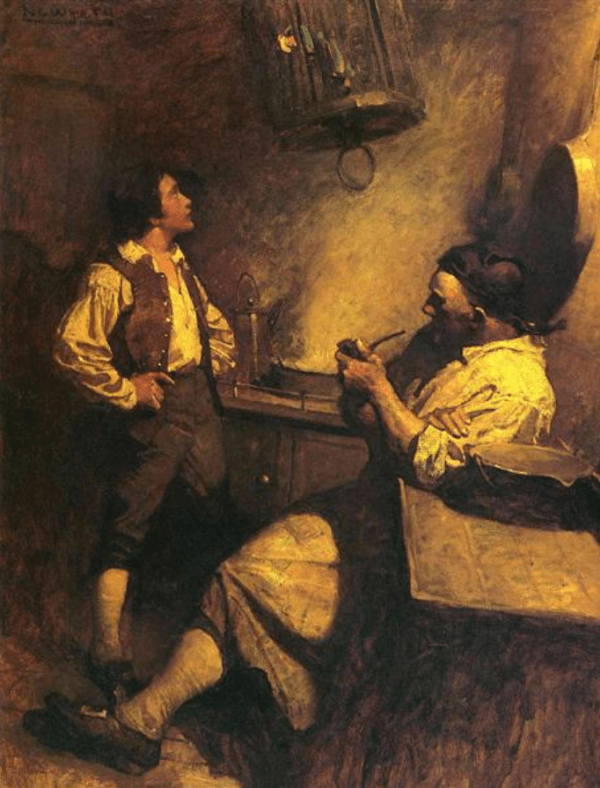
Of knights, a parrot, piracy, and the list as treasure chest

by Martha Rust

In his essay “A College Magazine,” Robert Louis Stevenson (1850-1894) reminisces about his boyhood strategies for accomplishing a cherished goal: becoming a writer. These self-assigned exercises included describing the world around him, copying down remembered conversations, and, what he found most profitable to his growth– imitating works he admired.

Continue reading “Of knights, a parrot, piracy, and the list as treasure chest”

A Cabinet of Conundrums: An 1846 List of Proposed “Curiosities” for the Smithsonian Institution

by Leslie Myrick and Martha Rust

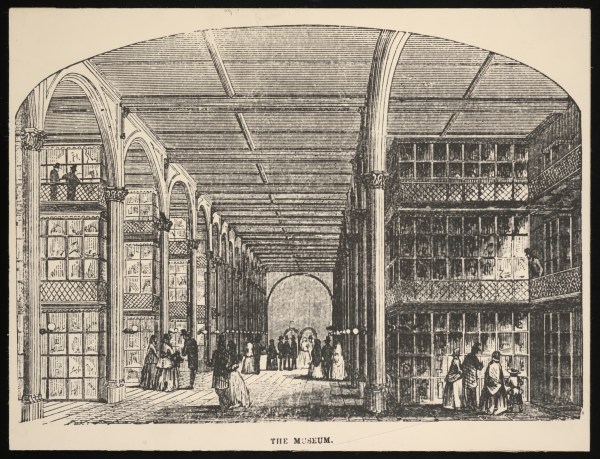
In July 1836 the United States Congress was the contingent beneficiary of a $500,000 bequest made by English scientist James Smithson (1765-1829) for the establishment of a new National Museum in Washington, D. C. to be known as the Smithsonian Institution. Smithson, the illegitimate son of Hugh Percy, the first Duke of Northumberland, never married and named a nephew as heir to his considerable fortune. When the nephew died without issue six years after Smithson’s death in Genoa in 1829, the bequest was duly transferred to Congress for the foundation of an American National Museum. A museum, as noted in our recent post “L’allure de liste,” can be a site that both contains list-like arrangements of objects and inspires written lists of the same. In the case of the Smithsonian museum, a curious list of proposed objects suggests that the list form itself could be the subject of a museum exhibition.

Continue reading “A Cabinet of Conundrums: An 1846 List of Proposed “Curiosities” for the Smithsonian Institution”

“Every Variety of Professions”: Ships’ Passenger Lists from Two New England Gold Mining Companies in 1849

Robert B. Honeyman, Jr. Collection of Early California and Western American Pictorial Material, The Bancroft Library, Berkeley, California

by Leslie Myrick

In honor of Labor Day this post takes a look at what a couple of member lists of mining and trading companies that left for the California gold rush early in 1849 can tell us about the exodus of skilled tradesmen from Eastern cities and towns and the economic impact of that exodus. An estimated 50,000 people, primarily young men, traveled by land and sea from the Eastern states to seek new opportunities in California in the year 1849 alone.

Continue reading ““Every Variety of Professions”: Ships’ Passenger Lists from Two New England Gold Mining Companies in 1849”

L’allure de liste: The Look of a List

by Martha Rust

Is it right to call a collection of images or things a list? In an early Listology post, “Ten Essentials for hiking,” we raised this question and in subsequent posts, “#adorablepets: Why Instagram Loves Lists” and “Lists and/as Artworks,” we answered it with a resounding “yes.” Following those entries, my own “Two Lists of Labors in Honor of Labor Day” and a “A list on the work of things” took the propriety of both “visual lists” and lists of things all but for granted. 

Continue reading “L’allure de liste: The Look of a List”

Lists of Knightly Accolades in the Liber Memorialis Friderici III. Imperatoris

by Alicia Lohmann

In 1436, shortly after his accession to power as duke, Frederick V, who would later become Emperor Frederik III, decided to make a pilgrimage to the Holy Land. After his return he created a list of knightly accolades, or dubbings (“Ritterschlagsliste”), in the so-called Liber memorialis Friderici III. imperatoris (Vienna, Austrian National Library, Cod. 2674, f.3), which provides information about the nobles who were knighted alongside Frederick at the Holy Sepulcher.[1] The young duke traveled to the center of the Christian medieval world, accompanied by at least 50 nobles and Bishop Marinus of Trieste. The list reads as follows:

Continue reading “Lists of Knightly Accolades in the Liber Memorialis Friderici III. Imperatoris”

List Restoration: An Interview With Athena Kirk

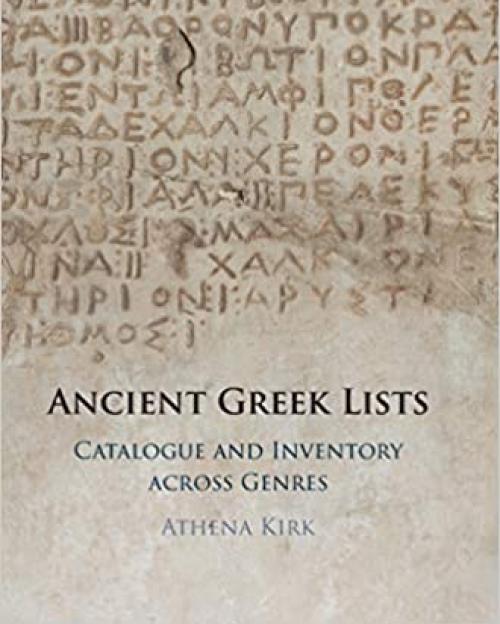
When asked to name the most famous and also oldest and longest list in literature, many a listophile would choose Homer’s catalogue of ships in the Iliad, and we would probably be correct. But would any of us have a sense of what an infinitesimal fraction of ancient Greek lists Homer’s ship list represents? Athena Kirk’s book Ancient Greek Lists: Catalogue and Inventory Across Genres (Cambridge University Press, 2021) raises the curtain on the multitudinous lists produced by the list-loving culture in Greece during Homer’s age and for generations to follow. Given its field-opening findings, we are pleased to introduce Kirk’s book to our readers by way of  the following interview with her.

Continue reading “List Restoration: An Interview With Athena Kirk”

Blog at WordPress.com.

Up ↑