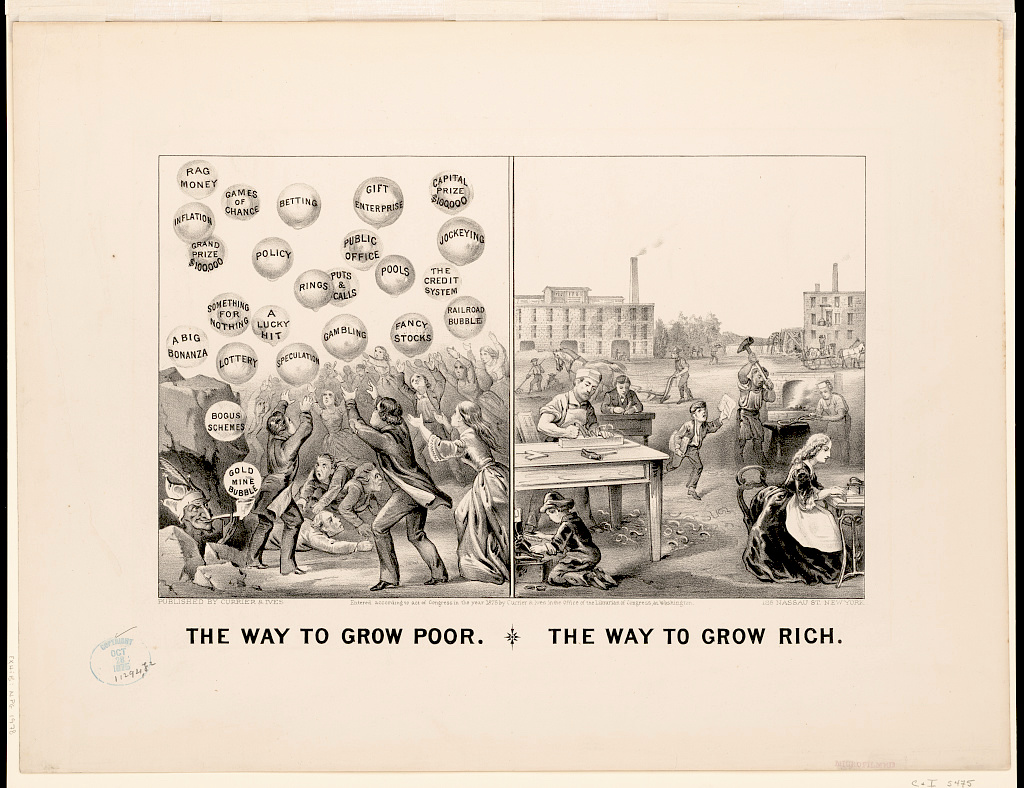
Currier and Ives, 1875, courtesy of The Library of Congress, Prints and Photographs Division. Digital ID pga 10125
by Leslie Myrick
The Currier & Ives lithograph at the head of this post depicts two panels: the first, “The Way to Grow Poor,” features a Pied Piper figure blowing various soap bubbles labeled “Gold Mine Bubble,” “Gift Enterprise,” “Fancy Stocks,” etc., enticing an unruly mass of townspeople (apparently lost in the wilderness) to chase after them; the second, “The Way to Grow Rich,” lays out an idyllic scene of universal industry: farmers, clerks, carpenters, newsboys, a woman at her sewing machine, etc., all framed in the background by massive factories and well-manicured lawns. The pipe blower’s two dozen bubbles featured in the left-hand panel cover a host of perceived economic and social evils plaguing mid-nineteenth-century society and political economy, most of which fall under a general rubric of speculation and humbug. One of the speculative bubbles pictured here–Gift Enterprises–will be the topic of this post, which Wille examine lists of prizes in newspaper advertisements for two charity gift enterprises published during the spring/summer of 1866 in the Cincinnati Enquirer.
In the eighteenth and nineteenth centuries, gift distribution or gift enterprise schemes, often in the form of private, mercantile speculations, sprang up in cities and towns throughout the U.S. They flourished especially during economic panics, and in the aftermath of the American Civil War. These schemes were essentially a form of lottery, in which a consumer could win a surprise “premium,” “gift,” or “present,” either in return for a small payment, or as “something for nothing,” e.g. in gift book enterprises, where a lottery number printed on the back of a purchased book entitled the buyer to a chance at a prize, or concert gift enterprises, where the event ticket was also a lottery ticket.[1 In a majority of cases it can be confidently stated that these enterprises were, in one way or another, swindles. From time to time, town and city councils moved to make them illegal, but they inevitably reappeared in times of economic stress. A clever “businessman” could manipulate these schemes in a variety of ways. Not infrequently, the owner of the gift enterprise and/or his agents merely absquatulated with the cash, leaving their victims with unredeemed tickets. Sometimes the system was rigged so that tickets for the least valuable items were sold first (or exclusively) while the most attractive prizes were “won” by shills and returned to the owner for future schemes. Moreover, the odds were often such that many a prize envelope contained a blank ticket. When a ticket holder walked away with a “gold watch” or a “silver pen,” the item was more often than not cheap, plated, and brassy.
The common early practice in the U.S. of supporting charitable causes through lotteries laid the foundation for charity scams, in which unscrupulous lottery men made arrangements with charitable institutions to set up gift enterprises to support asylums for war orphans, war widows, injured soldiers, and the like, but kept back inordinate amounts of the “earnings” for overhead, and/or manipulated the outcome in the ways listed above. These schemes were rife in the aftermath of the American Civil War. Newspaper editors railed against the practice:
So long as churches and charitable institutions encourage the lottery business in its fairs and gift enterprises, there is no hope of putting a stop to this invidious form of gambling. Professional lottery men avail themselves of the advantage of a thin mask of charity to carry on their business unmolested. The way the business is done, is to offer some benevolent institution a certain percentage of the profits for the use of its name as a gift enterprise, and the bait is too often accepted. Whether a gift enterprise is conducted in good faith or not, its effects are equally mischievous. (Brooklyn Eagle, 15 November 1867, 2)
Advertisements for two charity gift enterprises ran in Cincinnati papers throughout the spring and summer of 1866: a Grand Gift Distribution for the Benefit of a Permanent Home for Newsboys in Cincinnati, and a Grand Gift Concert for a Poor House and Widows and Orphans Home in Covington, Ky, just across the Ohio River. In both cases enough money was raised to achieve the intended ends: the newsboys had a new home in Cincinnati by October 1866,2 and by March 1867 an orphanage was established in Covington. However, an examination of the lists in the two advertisements discussed below suggests that one of these charity enterprises may have been less legitimate than the other; the suggestion is supported by newspaper accounts of the results. Aside from providing a primer on “reading” a prize list to ascertain its trustworthiness, this post will also examine some interesting differences in advertising strategies between the two lists.
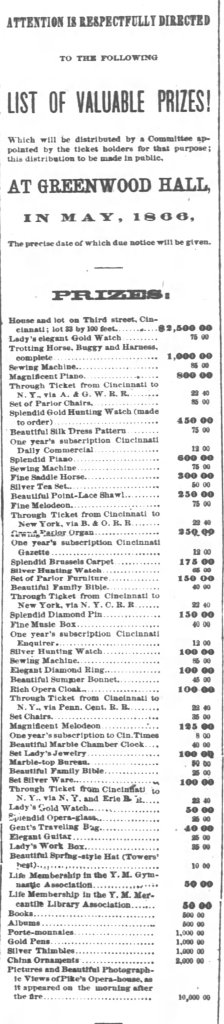
The first advertisement for “The Grand Gift Distribution for the Benefit of the Newsboys’ Home” appeared in the Cincinnati Enquirer on 24 April 1866, announcing that it would be under direct supervision of the Home’s Board of Directors, and that every ticket would draw a prize—in other words, the organizers would not flood the market with blank tickets. Otherwise, they offer very few administrative details, e.g. no total worth of offered prizes, and no mention of a set limit on the number of available tickets. An advert placed two days later called attention to their “List of Valuable Prizes!” (see fig. 1) to be distributed in May, “the precise date of which due notice will be given.” Unlike many Gift Enterprise organizers, for whom continuous delays meant more profit, they were true to their word. In a letter to the editor announcing the drawing on 30 May, the Board offered thanks to several firms “for their very liberal discounts made on articles purchased of them to be drawn in the Grand Gift Distribution.” (Cincinnati Enquirer, 17 May 1866, 2)—a detail which further supports the legitimacy of the Distribution.
A glance at the list of premiums reveals that it does not follow the general pattern of concentrating its most expensive items at the top, followed by the less attractive prizes in order of descending value. Instead, the “special inducements” are interleaved with less valuable offerings, but their values are printed in bold type, to catch the eye. The grand prize, a $2500 house and lot in Cincinnati, stands at the head of the list. Since this is a Newsboy charity, the usual household and prestige items—trotting horse, sewing machine, magnificent piano, silver tea set—fall in with subscriptions to several Cincinnati newspapers. At the end of the list, the cheaper items—books, albums, thimbles, 10,000 “Pictures and Beautiful Photographic Views of Pike’s Opera-house, as it appeared the morning after the fire” (on 22 March 1866)—are listed, not by price, but by the number available. Some 16,000 of these less expensive trinkets, along with the several subscriptions to Cincinnati papers, make up the bulk of the draw.
The lack of organization in this list goes against another norm in this genre of advertising, i.e. grouping the prizes by category: all the real estate, jewelry, household items, tools, etc., together. The random presentation may have been a strategy rather than an oversight, since it forces the reader to keep reading to find the prize he/she might be interested in winning.
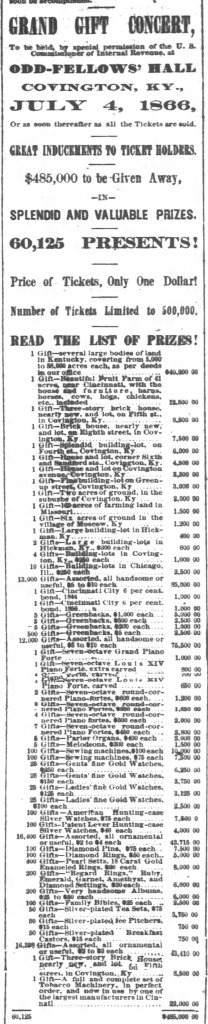
Advertisements for “A Grand Gift Concert to benefit a new Poor House and Widows and Orphans Home” in Covington first appeared in the Cincinnati Enquirer in late April 1866, outlining a plan to raise $100,000, of which $50,000 or $60,000 was projected to buy land and buildings, with the balance invested to provide income to make the asylum self-sustaining. The organizers, Clayton & Young, claimed to have secured $485,000 worth of prizes,3 presumably either donated or sold to them at wholesale prices, translating to 60,125 “presents” to be “given away” for $1/ticket, with a limit of 500,000 tickets.4 In other words, if all the tickets were sold, 439,875 tickets would be blanks. The original date of the drawing was set for 4 July 1866, “or as soon thereafter as all the tickets are sold,” according to the very small print. The drawing was, however, repeatedly postponed until late November, months after the originally set date in July.
The slickness of Clayton & Young’s advertisement is obvious from the outset, exemplified by the mise-en-pageof the list and its headers in the figure to the left (Cincinnati Enquirer, 26 April 1866, 2). Stacked heads culminate with an invitation to the reader to “Read the List of Prizes!”, whose items are, in general, systematically ordered, beginning with the most valuable, and are, for the most part, grouped by category. Compared to the previous list, this list of “gifts” is eye-popping. It opens with a singularly attractive prize of several large tracts of land in Kentucky worth $40,000 ($1,600,000 in today’s currency by a straight inflation calculator, but worth much more with adjustments for the real estate market); next is a fruit farm, followed by two dozen homes or lots, including 10 city lots in Chicago. To the modern eye, the sheer mass of real estate offerings strains credulity. Sandwiched between the real estate and several gifts of bonds and greenbacks is an item consisting of “13,000 Gifts—Assorted, all handsome or useful, $5 to $10 each.” This, along with three similar tranches of assorted useful items, may well have been what most people drew. The total number of these “useful gifts” came to 57,798. The list goes on: bonds, greenbacks, seven-octave Louis XIV piano fortes, parlor organs, sewing machines, watches, diamond pins, tea sets, etc etc, ending, anti-climatically, with “A full and complete set of Tobacco Machinery, in perfect order.”
Appended to the prize list (not included here) is a long list of references for Clayton & Young and a letter from a committee appointed by the Covington Common Council approving of their management of the benefit—notably, the sort of certification used by nineteenth-century patent medicine dealers. From its mise-en-page and the details of organization to the shock and awe of the offerings, this list appears to be the product of a professional lottery man, and it was. James Clayton is listed as an agent for the Kentucky State Lottery in Covington in 1864.
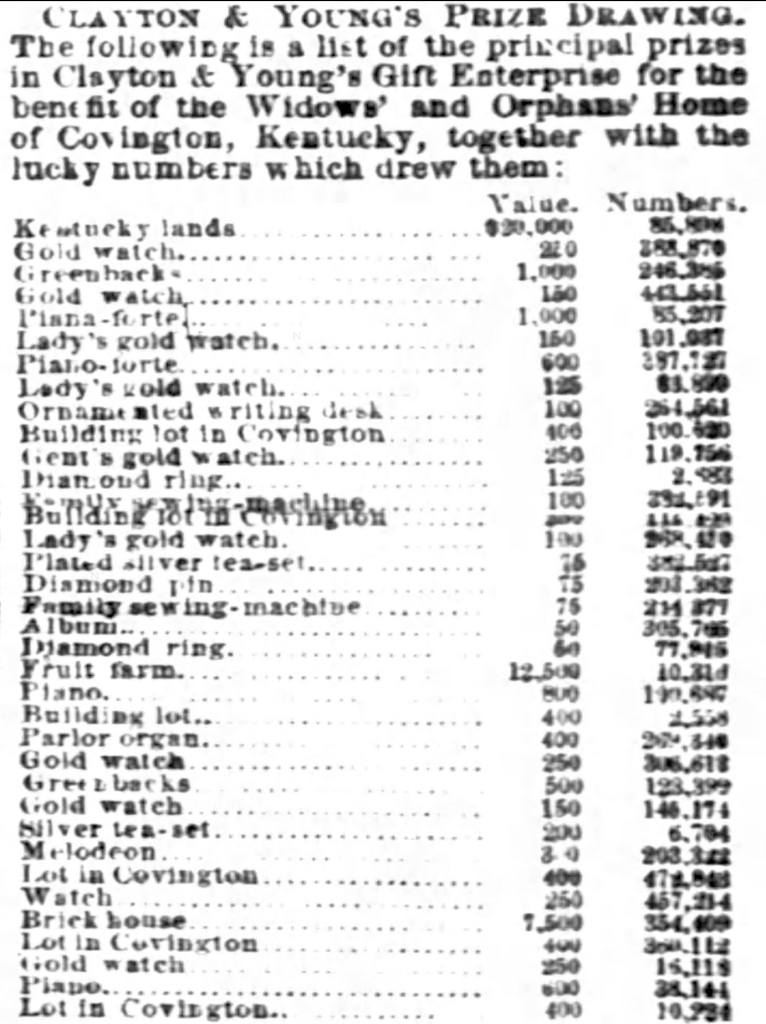
The professional flair of the original advertisements is nowhere to be found, however, in the printing of the winning numbers in the Cincinnati Enquirer on 27 November. In contrast to the tightly organized original prize list, the list of winners has no organizing principle beyond placing the grand prize, a large Kentucky estate, at the top. The prizes are not, as before, grouped by category, nor is the list ordered by winning number. This random ordering makes it difficult, on the one hand, for a ticket holder to ascertain if his/her number is a winner, and on the other, it obfuscates the fact that several of the items on the original prize list do not appear on the winnings list, which comprises a tiny fraction of the original “special inducements.” For instance, of the twenty “gifts” of piano fortes, only four are accounted for on this final list of winning tickets.
A week after the winning numbers were announced, one P. L. Cole, of Washington County, Ohio,5 who claimed to have drawn the grand prize ticket for $40,000 worth of Kentucky real estate, brought suit in Kenton Circuit Court against Clayton & Young, the members of the committee, and others, for refusing to convey the property he had won. The Cincinnati Enquirer published a short notice of the suit: “The plaintiff alleges that the defendants have failed and refused to convey the land, and he, therefore, asks judgment for the money. Persons who are in the habit of investing their money in ‘gift enterprises for great charitable purposes,’ will doubtless watch the progress and developments of this suit with much interest” (“Heavy Suit,” Cincinnati Enquirer, 6 December 1866, 1). No further news of the outcome of the suit has been recovered, however, in the limited pool of digitized Cincinnati and western Kentucky newspapers. As the Cincinnati Gazette noted (6 December 1866, 1), the defendants were all “men of wealth,” and the plaintiff, who was not, may have been satisfied with winning a settlement out of court far short of $40,000, as a return on his $1 ticket.
By August 1866 the Covington Gift Enterprise had brought in enough money for the committee to feel confident enough to place a bid on a farm and land for $16,000, and by October they had made the first down payment. In March of the following year the Asylum was open for business, but, as monthly city treasurer’s reports demonstrate, the promised endowment for maintenance, unsurprisingly, did not materialize. As early as January 1868 the city Committee on Workhouses and Jail reported in favor of selling the farm that housed the Asylum and donating half the proceeds to a hospital that could take in the residents, expressing the opinion, according to the Enquirer, that the home was “an elephant on the city’s hands and that the animals should be speedily disposed of” (Cincinnati Enquirer, 24 January 1868, 2). Despite several attempts to close it down, the institution (and its residents) eked out a spare existence until 1880, when at length a philanthropist, Amos Shinkle, donated funds to construct a new Orphan’s Home, and established a trust for its maintenance.6
For an excellent survey of these practices, see Kristen Highland, “Gambling on a Sale: Gift-enterprise Bookselling and Communities of Print in 1850s America,” Knygotyra 78 (1 Nov 2022): 17-45. ↩︎
In his director’s report on the fund-raising for the Newsboy’s Home, Rev. M. P. Gaddis revealed that, while he had been out of the city, the Board had contracted with H. W. Coffin, a commission merchant, who offered to hand over half of the proceeds of a Gift Enterprise for the Home, and keep half for himself, a typical bargain at the time. He was eventually persuaded to take a smaller, fixed sum of the proceeds as payment. (Cincinnati Gazette, 13 October 1866, 1). ↩︎
In today’s currency the premiums added up to around $19,400,000. ↩︎
To put the numbers in context, the 1860 census for Cincinnati listed 161,000 residents, with another 16,000 across the river in Covington. ↩︎
Most likely Philip L. Cole, a young stone mason from Warren, Ohio. ↩︎
“Protestant Orphans’ Home,” Cincinnati Star, 4 March 1880, 5; “Homeless and Friendless,” Kentucky Journal, 16 September 1880, 8. ↩︎


Leave a Reply