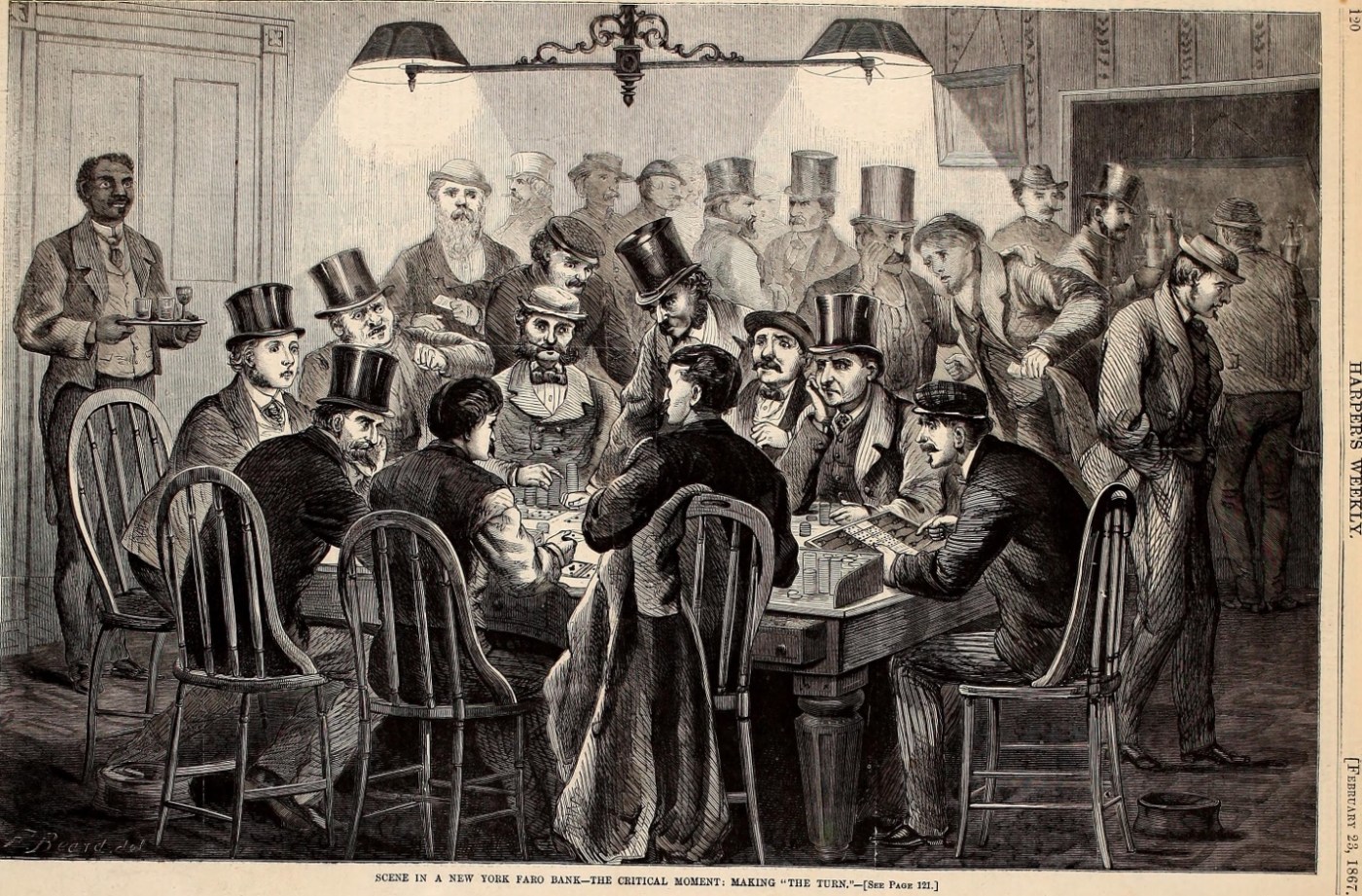
“Scene in a New York Faro Bank,” Harper’s Weekly, 23 February 1867: 120.
by Leslie Myrick
Charles Godfrey Leland, (1824-1903),[1] Philadelphia-born journalist, folklorist, translator of German poetry, and writer on the Romani and the occult, is best remembered as the creator of the humorous balladeer “Hans Breitmann,” who made his first appearance in “Hans Breitmann’s Barty” in the June 1857 issue of Graham’s Magazine. As a lexicographer of slang as a sub-category of folk language,[2] Leland was also a creator and a connoisseur of lists. This post will examine a list of slang words for “money,” which he published in two different formats while working as a journalist in Philadelphia in1855 and 1857.
An early example of his interest in slang can be found in Meister Karl’s Sketchbook, a record of Leland’s youthful “tourifications, trapesings, tramps, trudges and travels through this wavy and windy world,”[3] published in book format in 1855, but written when he was between the ages of 16 and 25. In an account of how savvy travelers pass contraband (Havana cigars, French wines, Bibles) through customs at Rome, Leland produces a list of some three dozen slang terms for “money”:
Contraband! fudge! The blessing of the priest converts flesh into fish; the skill of the restaurateur changes pet pussies into favourite dishes ; the learning of the cosmetic-chemist metamorphoses age into youth; the wisdom of Solomon Isaacs transmogrifies old garments into new; the tact of the lawyer makes the worse appear the better cause ; and the magic spell of the ready otherwise known as money, cash, tin, stuff, rhino, [4] root-of-all-evil, blunt,[5] wherewithal, rowdy, [6] funds, stumpy, [7] pecuniary, dibs,[8] hard, browns,[9] heavy, mopusses,[10] slugs, shiners, [11] lucre, or “the filthy,” dust, gelt, chips, lumps, chinkers,[12] mint-drops,[13] pewter, brass, horsenails,[14] rocks, brads,[15] spondulix,[16] needful, dough,[17] spoons, buttons,[18] dimes, or the infallible will convert every article and item in that old sole-leather into “duty free.”[19]
He revisited this list two years later, transforming it into verse written in trochaic tetrameters, clearly intended to parody Longfellow’s “Song of Hiawatha” (1855), in his first “Editor’s Easy Talk” column for Graham’s Magazine.
There Leland recounted a tale in which a quick-thinking village policeman in France prevented a group of rowdy young men from disrupting a newly married couple’s wedding night with a charivari—a serenade consisting of “tin pans, old bones, and other discordant promoters of a disagreeable noise”—by devising a false report that a tiger had escaped from a menagerie in a neighboring village, thus sending the prospective serenaders to the safety of their homes for the night. Picking up on the current idiom “fighting the tiger” (i.e. gambling at faro), in the next paragraph Leland presents a poetic list of 38 slang terms for “money,” enumerating all varieties of coin, good and bad, which gamblers were bound to lose at the faro bank:
Happy villagers, they were afraid to “fight the tiger,” as gambling is popularly termed at the virtuous village of Newport, in particular, and everywhere else, in general. Young gentleman, never be afraid to fight the tiger, he is a dangerous “animile.” We have heard of one who went to fight the tiger:
“Went to fight the furious tiger,
Went to fight the beast at faro,
And was cleaned out so completely
That he lost his every ‘mopus,’
Every single speck of ‘pewter,’
Every solitary ‘shiner.’
Every ‘brad’ and every dollar,
All the ‘dough’ in his possession,
All the ‘spoons’ his labor earned him,
All the bright and lovely ‘ready.’
All the ‘rowdy’ and the ‘stumpy,’
All the cash and all the ‘rhino,’
All the ‘tin’ we did inherit,
All the ‘dibs’ we could discover,
All the ‘browns’ his uncle left him,
All the ‘chips’ and ‘dust’ and ‘chinkers,’
All the ‘dimes’ and all the ‘horsenails,’
All the ’brass’ and all the ‘needful,’
All the ‘spondulix’ and ‘buttons.’
All the ‘rocks’ and all the ‘mint-drops,’
All the ‘lumps’ and ‘filthy lucre.’
All the ‘gelt’ and all the ‘heavy.’
All the sweet ‘pecuniary,’
All the ‘hard’ and all his funds too,
All the ‘wherewithal’ and ‘scabs’[20] too,
All the ‘root of every evil,’
All the ‘circulating mediums,’[21]
All the ‘mammon’ he had gathered,
All his money in a word.”
(“How to Stop a Serenade,” Editor’s Easy Talk, Graham’s Magazine 50 (Jan 1857): 81.)
Material of this sort from Graham’s Magazine, a popular literary monthly, was widely excerpted by newspaper exchange editors. We find the poem almost immediately reprinted, without attribution, and rather cheekily adapted to another purpose, in a California paper (“A Rat,” Butte Record, 10 January 1857, 2.). This “flight of synonyms”[22] was particularly popular in California, the land of faro banks, as well as in Missouri, Arkansas, and Kentucky.
This raft of terms, taken altogether, can be broken down fairly simply into a rough set of categories, depending on each one’s (possible) derivation or etymology. Although the following analysis does not construct an exhaustive taxonomy, admitting, as it does, of some overlap, and leaving a few puzzling outliers (e.g. “dimmocks”), I offer it as an attempt to sort these terms into some reasonable order:
Material aspects of a coin:
Material from which it’s made: brass; coppers; dust (i.e. gold); gelt; pewter; rags; tin;
Color: browns; ochre; rowdy (“ruddy”); yellow-boys;
Decoration: queen’s pictures;
Related “shiny things”: brads; shiners; spoons;
The sound it makes: chinks; chinkers;
How it feels: blunt; hard; stiff;
Its availability: needful; ready; wherewithal
Metonymic relationships (purses, etc): haddock; horsenails; skins
Other objects shaped like coins or used as currency in games or the wider economic sphere: beans; buttons; chips; corks; dibs; lumps (i.e. of gold); rocks; spondulix (?)
Secondary / Linguistic origin:
Latin derivatives: dinarly (< denarius); lucre (< lucrum); pecuniary (< pecunia)
Abbreviated terms in English: rhino (possibly from sovereign)
Puns: mint-drops
From terms of exchange/place or method of money-getting: bustle; circulating medium; nobbings; palm oil; quids; stumpy
Moral terminology: “the filthy;” mammon; root of every evil
Special terminology for bad coins: mopus; scabs; slugs
The reuses of this catalogue of terms demonstrates how some lists, especially in the context of 19th-century periodicals, could “go viral,” beginning with the author’s repurposing of a list of the variety of coins that could be used to bribe a customs officer in Rome, then applying it in verse format to the many ways a man could lose “all his money, in a word’ at the faro table. The Butte Record reprinting referred to above, but not copied, embedded Leland’s list, unattributed, in an editorial tirade against a political adversary. At least two score other editors extracted these verses and reprinted them, in most cases, without any attribution, as a clever etymological exercise with a moral message. Leland, who has been labelled one of the most underrated writers of the 19th century, proved himself in this instance a master of list-making.
[1] Leland, who studied at Princeton, Heidelberg and the Sorbonne, returned to Philadelphia from his many European adventures, which included manning the barricades in Paris during the 1848 revolution, to pursue a career in law. After an unsuccessful few months in the field, he moved to New York, having been invited to work on Barnum’s Illustrated Newspaper, then edited by his friend, notorious Poe-defamer Rufus Griswold. He soon returned to Philadelphia, however, where he secured an editorial position on the Evening Bulletin and served concurrently as the literary editor of Graham’s Magazine beginning in January 1857. After serving in the Civil War, he returned to Europe to research the folkways of a variety of cultures, including slang, or “folk language.”
[2] In 1889 he published A Dictionary of Slang, Jargon and Cant, co-edited by Albert Barrère (1846-1921). A revised edition followed in 1897: A dictionary of slang, jargon & cant embracing English, American, and Anglo-Indian slang, pidgin English, gypsies’ jargon and other irregular phraseology. According to Leland’s niece and biographer, Elizabeth Robbins Pennell, paid contributors to the dictionary included such luminaries as Oliver Wendell Holmes, George Washington Cable, Lafcadio Hearn, James Russell Lowell, Thomas Higginson and Max Muller.
[3] Ch. 13, “Yankee Stories,” p. 259.
[4] Of uncertain origin, according to the OED; citing its first use to 1628. Barrerre and Leland make several suggestions, including a derivation from Danish reno, “fine, brilliant, shiny.” Green’s Dictionary of Slang, s.v., suggests it may be a clipping of “sovereign.”
[5] Green’s Dictionary of Slang, s.v., traces this usage back to 1703, and suggests several possible origins: from blond, for yellow coins; or blunt, referring to the edge of an unmilled coin; or from John Blunt, chief architect of the South Sea Bubble of 1720.
[6] Possibly from “ruddy,” describing a gold piece. So Barrere and Leland, Dictionary of Slang, Jargon and Cant (1889), s.v.
[7] “That which is paid on a stump,” according to the entry in Barrere and Leland, s.v. See also the entry for “stump” in the revised edition of Grose’s Classical Dictionary of Slang (1823). And compare “to be stumped,” meaning “to be without money.”
[8] Possibly from a children’s game played with knucklebones.
[9] Green’s Dictionary of Slang, s.v., “a halfpenny; a penny; thus browns, copper coins; a cent.” “Browns and whistlers” were, according to coiners, bad half-pence and farthings (Grose’s Dictionary, s..v.).
[10] Of unknown etymology. Refers to a worthless person or a coin of little value; a farthing. See B. E., A new dictionary of the terms ancient and modern of the canting crew (1699). Green’s Dictionary of Slang, s.v. traces it back to 1639.
[11] Can refer to a ten-cent piece or a gold sovereign.
[12] From the verbal form “to chink,” a variation of “to clink, make a ringing sound.”
[13] “Benton’s mint-drops,” was an early slang term for money, named for Thomas Hart Benton (1792–1858), five-term senator from North Carolina, who advocated for the use of hard currency or gold coin (specie) “dropped from the mint” rather than paper currency backed by gold.
[14] Green’s Dictionary of Slang, s.v. “bags of sovereigns,” from Cambridge Independent Press, 4 Dec 1852.
[15] A half-penny or a cent; see Richard Hardy Vaux, A New and Comprehensive Vocabulary of the Flash Language (1812).
[16] More commonly seen as “spondulicks,” popular from the 1840s. OED deems it “of fanciful formation,” but it appears to derive from spondere, “to promise [e.g. to pay a note].” It may possibly be related to Gk. sphóndylos “spine,” whose vertebrae resembled a stack of coins. See also dibs.
[17] First appeared in Bartlett’s Dictionary of Americanisms (1848), s.v. tin.
[18] Francis Grose, A Classical Dictionary of the Vulgar Tongue (1785), s.v., a counterfeit shilling.
[19] “Chapter the Twenty-Second, Of Rome and Divers Things Therein and Thereout,” Meister Karl’s Sketchbook, Philadelphia 1855, 166.
[20] Probably referring to bad coins; cf. the use of “scab” to denote a person who crosses a picket line or does the work of someone on strike, c.f. rat, blackleg.
[21] Common terminology used as early as the mid-18th century for a “medium of exchange” in commerce.
[22] So described by the editor of the Oswego Daily Palladium, 13 January 1857, 3, who praises its “high degree of etymological excellence.”
 Listology
Leave a comment