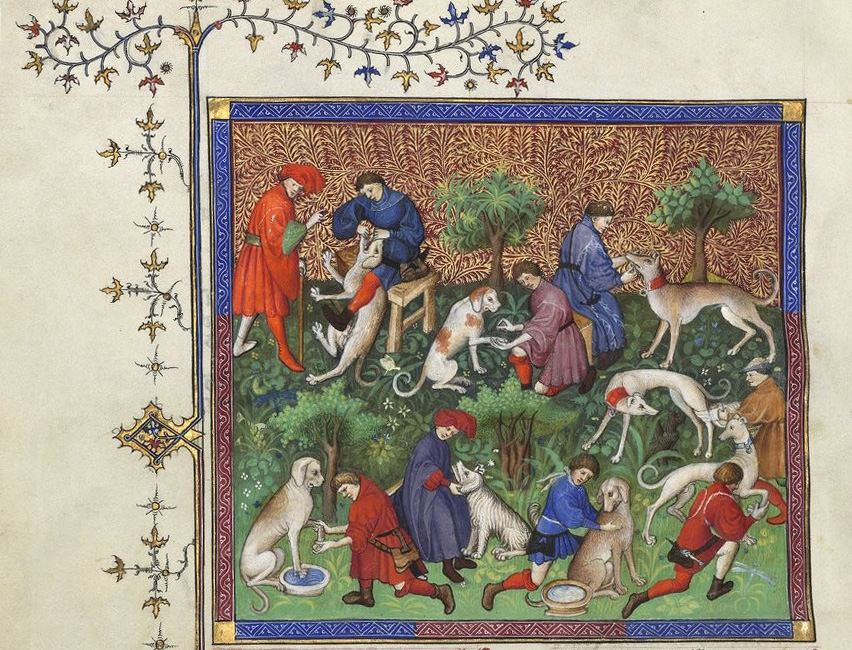
Gaston Phébus, Livre de la Chasse, Bibliothèque Nationale de France, MS Fr. 616, f.40v. Source gallica.bnf.fr / BnF
Few scholarly articles on medieval topics become internet sensations, but Professor David Scott-Macnab’s “The Names of All Manner of Hounds: A Unique Inventory in a Fifteenth-Century Manuscript,” published in 2013, was that one in a million.[1] The article features a list of no fewer than 1065 names for hounds–alphabetically ordered from “Argente” to “Yonkir”–prefaced by a discussion of the great affection medieval hunters felt for their hounds.[2] Many bloggers picked up the article; it has been the topic of several Reddit conversations, and one fan even used its list of names to create a dog-name generator. More than ten years after its publication, the article’s fame continues, as evinced by a Google search that auto-completes after “the names of all man” (individual results may vary). As editors of a blog devoted to the study of lists, we were eager to contribute to the online discussion of this famous list of names for dogs and invited Professor Scott-Macnab (of North-West University) to do an interview with us, which he kindly accepted.
Listology: Regarding your article’s internet fame: perhaps it springs from people’s ongoing affection for their dogs? And (dare we at the Listology blog hope) affection for the list form as well? For example, could it be something about the form’s capacity to hold any number of items, exemplified by this list’s impressive 1065 names? Or could it be about the way a list may instantiate a category of things but may just as easily hold a miscellany, the way the alphabetical order of this list makes for a semantic hodge-podge of terms under any given letter–like Argente, Aldirman, Archer, Archebawde, Absolon, and Awgere, the names beginning with the letter A?
DSM: Many thanks for your kind introduction and for this wonderful opportunity to say a few more words about the unique list of medieval English dogs’ names that I published back in 2013.
Medieval manuscript miscellanies are full of lists of all sorts of surprising things, such as the names of bishoprics or the parish churches of London, different types of dogs, the different words used for referring to a hawk’s foot and feathers, the qualities to look for in a hawk, a horse, or a greyhound. These are often written out as ‘long lines’, making them look like a paragraph of prose. What is really surprising about the list of dogs’ names that I found is the care with which it has been constructed as a list: the names are alphabetically divided, have headings, and are written in three columns down the page. In that respect, the list conforms very strongly to our modern conceptions of what a list should ‘look’ like and how it should be constructed. Yet, surprisingly, the names themselves are not, as you observe, strictly alphabetical, so it seems that medieval ideas of how to structure a list are rather more flexible than our own. In other words, what we see as a hodge-podge of names beginning with each letter of the alphabet would have been perfectly OK to them. Like a list written across the page, these also ask us to read as medieval people would have seen them. I did think of alphabetizing the names, but decided to be true to the manuscript and its compiler and show them as they appear in the manuscript.
It’s also worth noting that there are other organizational principles at work too. For example the two names beginning with the element ‘Christ-‘ (Christall, Christabell) look as if they are written with an X-, which is why they come after W. But X is simply an abbreviation for Christ-. Likewise with the names that come after Z: Etwyn, Etkyn (these are written with the symbol &, which is the abbreviation for Latin Et-); so too the pair Contacte, Converse, which are written with the abbreviation for Latin Con-. Because they are written with symbols, the scribe decided to place these names outside the alphabetical sequence.
Listology: On the topic of categories, you take pains in the article to point out the many types of names the list includes, in the course of which you become a list-writer yourself. You list many of its proper (human) names–Absolon, “Charlemayne,” “Creseyte,” Achilles, and Albert, for instance–and then provide a list of the following nine other categories of names with examples of each. We present all nine below along with three examples from each:
Desirable qualities and abilities of hunting hounds
Birdismowthe
Blodeman
Creper (Creeper)Physical characteristics
Russette
Tawne
WhiteberdeOther characteristics, qualities and temperaments, many suggesting of irony
Amyable
Bragger
BrawlereMinerals, plants and animals
Emerawde
Honysoke
SalmonToponyms
Derby
Florense
LyncolneNationalities
German
Norman
SaresynHuman occupations, titles and categories
Capteyne
Jeester
LeperMiscellaneous
Beste-of-all
Goodynowȝe (Goodenough)
Havegooddaye
These classifications recall medieval encyclopedias, which were organized by topics and often arranged hierarchically rather than alphabetically. For example, the Etymologies by Isidore of Seville (560–636) devotes one of its twenty books to animals, another to “stones and metals,” and another to names of nations (along with their languages, reign, military, and more).[iii] Faced with the task of organizing 1065 names of hounds, the fifteenth-century compiler of this list would have had knowledge of both the traditional, topical method and of the newer, alphabetical method of organizing information. Putting yourself in his place, why do you think he chose to organize the names alphabetically?
DSM: Thank you for seeing me as a list-maker! Briefly, as I explain below, I think the list was compiled and intended as a practical system for information retrieval in a working environment, and so was not built on encyclopaedic principles. In this regard, I am very aware that there is so much that can still be done in terms of analysing the list, but I think this should be done by an expert in onomastics, which I am not. When I first wrote this article it seemed that I was stretching the limits of the journal’s tolerance in terms of length, so I cut back on further analysis, little expecting the interest it would generate. I would have loved to render the names into more familiar modern English, as many are undoubtedly obscure to non-specialists. For example, the name Cere-ȝyne means ‘Waxy (that is, yellow) eyes’, which is wonderfully descriptive. Likewise Dyngill (‘dunghill’), Dasyberd (‘daisy-beard’: a hound with a white muzzle), Dere-ybouwȝt (‘dearly bought’, i.e. costly), Belamy (= French bel + ami, ‘beautiful friend’). Perhaps this is a task for another day, given the list’s popularity.
As to the origins of the list, the manuscript contains a copy of Edward of York’s hunting treatise Master of Game, as well as several other practical texts relating to field sports and country matters, such as a treatise on hawking. I like to think (though this is pure supposition on my part) that the list could be related to a working kennel associated with some important family’s country estate. We know, for example, from Froissart’s Chronicle that Gaston Fébus, count of Foix, had kennels of 800 couples of hounds (that is, 1600 animals), and they must have been known by name to the kennelmen and the huntsmen charged with controlling them in the chase. In fact, there are detailed instructions in the Master of Game on caring for hounds, and calling to them by name when they are hot on the trail. In other words, I’d like to think that this list is not the work of some bookish encyclopaedist (no offence to them), but a practical record, perhaps dictated to the original compiler by the keeper of his lordship’s kennels.
Listology: Still on categories, the list of names includes sub-categories under each letter in its alphabetic scheme: after “Houndis names,” there are names for “Braches” (female hounds), and names for “Tereris” (terriers). Do you see any general patterns in the marking of male versus female names? For example, does one list play on gender stereotypes more than the other? And if so how? On the list of terriers’ names, are these particularly suited to terriers? Or could some of them work equally well as names for hounds?
DSM: One of the things I noticed was that terriers seem to have a higher proportion of names suggesting bad temper; for example, Arguer, Brawler, Malapert, Quarrell. Perhaps this suggests that terriers were just as feisty in the fifteenth century as they are now. It also seems to me that there is a preponderance of names suggesting, or associated with, traditional feminine characteristics that are given to braches, for example, Hosewife (‘housewife’), Cowntese (‘countess’), Wenche, Mabbe (queen of the fairies), Flowre (‘flower’), Honysoke (‘honeysuckle’), as well as positive qualities, such as Joyous, Nurture, Amyable (‘amiable’), Beaute (‘beauty’). But then there is also Orribull (‘horrible’), so it’s really not advisable to make very sweeping generalisations.
I originally had more difficulty making sense of why greyhounds and female greyhounds (greybitches) should have distinct names from other hounds (though some are repeated). In this regard, however, it’s important to remember that for hunters greyhounds belong to a different category: they are gazehounds that hunt by sight, whereas the hounds and bratches listed earlier are scenting hounds that hunt with their noses. And terriers are diggers. The medieval huntsman would never dream of mixing them all up together!
Listology: Returning to the list’s spectacular length, do you have a hypothesis about how it was compiled? Was this list a product of the compiler’s collecting real hounds’ names over many years? Or was it more a work of his imagination?
DSM: As I say in answer to Question 2 above, I like to think that this list reflects someone’s knowledge and experience, perhaps of one or more working kennels. The manuscript as a whole is a collection of practical texts, so it would be surprising if this list were just someone’s personal fancy, although it is possible that some names are imaginative elaborations. Of course, we don’t know whether this list was written down by the person who compiled it, or whether it was copied from an earlier existing manuscript (I think this is more likely). The professionalism of the presentation, using both red and black ink, suggests strongly that it’s not just an off-the-cuff scribbling of ideas. So there may well be (or have been) an earlier version that is waiting to be discovered. It would be really exciting if this list circulated among gentleman hunters keen to get ideas on what to call their hounds.
Listology: If the latter, what does that say about list-making? For example, is it fun?
DSM: I am sure that the list-maker had a lot of fun, especially when it came to names that reflect dogs’ qualities or personalities, which are not always flattering (for example, Braynesike, Litillwitte). I get the same feeling about this list as I do with the longer lists of collective nouns. In their original form, these are simple, short, and practical, with straightforward phrases such as ‘a herd of deer’. But longer lists suggest that scribes began to indulge in imaginative one-upmanship, with phrases like ‘a skulk of friars’, ‘a superfluity of nuns’, ‘an impatience of wives’.
Listology: Related to that question, were there aspects of this list that made it particularly appealing to you?
DSM: Apart from familiar personal names like Absolon, Arthur, Mynerue (Minerva), the list contains hundreds of word-forms that are puzzling in many ways, and that still need to be properly analysed. For example, is Drainwhey to be understood as ‘drain away’ or ‘drainway’, and why should this name be given to a dog? The list offers an intriguing window on several small, but important, aspects of medieval life, such as the functioning of a hunting establishment, relations between kennelmen and their dogs, the psychology of naming working animals. Why is one dog called Besaunte (‘bezant’, a gold coin) and another Filthe? Did they not worry about the possibility of nominal determinism in giving animals names with negative associations? Since the list was ostensibly to be used in a rural setting, one wonders what a farmer’s list of names for a herd of cows might have looked like.
Listology: Do you have a favorite name on this list — or maybe a top three favorites? Relatedly, do you have a dog — and if you do, what is his or her name?
DSM: My favourite names are probably those that show elements of quirkiness or inventiveness, such as Tullymully, Turnebucke, and Rowte-owte. And I was fascinated to find the name Quonyam for braches. I’m sure you’ll remember that this is Chaucer’s Wife of Bath’s euphemism for her own private parts
I do have a dog, but I inherited her name from her previous owner. She is Peanut, so I would have to place her name with foods or plants. My previous dog was called Bubese, which is the Zulu word meaning ‘lion’.
Listology: How would you explain the fascination with lists and list-like structures in the medieval and early modern period? Do you see major differences to our modern techniques and uses of lists and list-making?
DSM: I am very aware that I am writing for an audience that probably knows far more about lists than I do, so I am going to be cautious in what I say. But it seems to me that all forms of naming, whether with common nouns or with proper nouns, is a way of ordering the world and giving structure to its variety and chaos. The next logical step is to organize those names into structures that can themselves be ordered if necessary. The medieval ‘ABC’, or abecedary (an alphabetical list, sometimes written as verse), is just such a system of ordering information, as well as being a handy way of retrieving it. A lot of medieval lists are quite short and are structured in a way that allows them to be a handy aide-memoire. This list is quite gargantuan, suggesting that it was intended for reading as a work of reference. That would also account for the care that has gone into layout and visual presentation of its information.
DSM: Once again, many thanks for inviting me to this interview.
Listology: You’re so welcome; thank YOU!
1] David Scott-Macnab, “The Names of All Manner of Hounds: A Unique Inventory in a Fifteenth-Century Manuscript,” Viator 44.3 (2013), 339-68. Scott-Macnab is a member of the English Department at North-West University, Potchefstroom, South Africa.
[2] The list contains no names beginning with “Z.”
[3] The Etymologies of Isidore of Seville, trans. Stephen A. Barney, W. J. Lewis, J. A. Beach, and Oliver Berghof (Cambridge: Cambridge University Press, 2006.
 Listology
Leave a comment