Weaving the Nation in the Feriby Counter-Roll and Medieval Romance

by Nick McKelvie

As I mentioned in my previous post, the final documented step of the textiles listed in the Feriby counter-roll (Kew, The National Archives, E 101/383/6) was their distribution to Edward III’s subjects; what I did not mention is that this gesture echoed a practice of the Great Khan of the Mongol Empire, who, according to Marco Polo, “gives rich clothing to [his] 12,000 barons and knights 13 times a year; he dresses them all in the same clothes— like his own, and very worthy.”

Continue reading “Weaving the Nation in the Feriby Counter-Roll and Medieval Romance”

Crowned with Cloth: A 1327 Counter-Roll Listing the Expenses of the Coronation of Edward III

by Nick McKelvie

The recent coronation of King Charles III has brought new attention to English coronation traditions, including the use of a “coronation roll” to document the details of the accession. The National Archives of the United Kingdom recently announced an exhibit, for example, titled “Happy & Glorious: Coronation Commissions from the Government Art Collection,” which displays the earliest coronation roll still in existence (produced for Edward II in 1308) paired with the recent coronation roll created for King Charles III.1 Edward II’s roll is only two feet long, whereas Charles III’s is twenty-one meters; more scandalously, while Charles III’s features Queen Camilla quite prominently, Edward II’s makes no mention of Queen Isabella, although it does reference Piers Gaveston, 1st Earl of Cornwall, who was rumored to be the king’s lover.

Continue reading “Crowned with Cloth: A 1327 Counter-Roll Listing the Expenses of the Coronation of Edward III”

Lists of Knightly Accolades in the Liber Memorialis Friderici III. Imperatoris

by Alicia Lohmann

In 1436, shortly after his accession to power as duke, Frederick V, who would later become Emperor Frederik III, decided to make a pilgrimage to the Holy Land. After his return he created a list of knightly accolades, or dubbings (“Ritterschlagsliste”), in the so-called Liber memorialis Friderici III. imperatoris (Vienna, Austrian National Library, Cod. 2674, f.3), which provides information about the nobles who were knighted alongside Frederick at the Holy Sepulcher.[1] The young duke traveled to the center of the Christian medieval world, accompanied by at least 50 nobles and Bishop Marinus of Trieste. The list reads as follows:

Continue reading “Lists of Knightly Accolades in the Liber Memorialis Friderici III. Imperatoris”

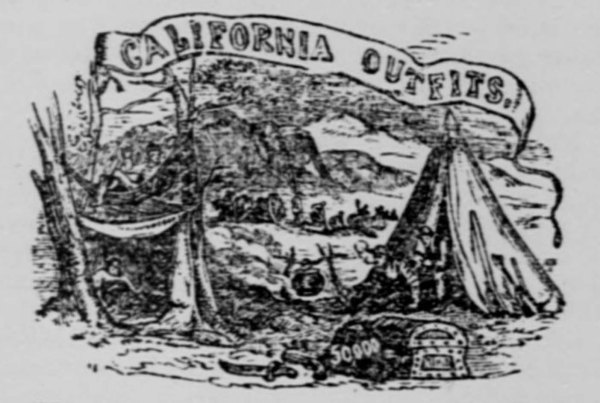
Outfit for California: Two and a Half Tons of Essentials for the Overland Trail

by Leslie Myrick

The electrifying news of the discovery of gold at Sutter’s Mill in the winter of 1848 compelled an estimated 80,000 adventurers to pack their bags for California in the following months. How they prepared for the journey—aided by the compilation of lists of provisions and outfitting equipment—depended on their intentions: whether to join the vast majority of travelers who went as itinerant gold hunters, leaving their families at home, or as settlers, picking up and moving with their families, in order to ply their own trade in the land of bonanza, e.g. as doctors or merchants. Continue reading “Outfit for California: Two and a Half Tons of Essentials for the Overland Trail”

ERC Starting Grant Project on Lists in Literature and Culture at the University of Freiburg

by Sarah Link and Anne Rueggemeier

“Joseph Stalin, Malenkov, Nasser and Prokofiev
Rockefeller, Campanella, Communist Bloc

Roy Cohn, Juan Peron, Toscanini, Dacron
Dien Bien Phu falls, Rock Around the Clock” …

Some of us might first feel the rhythmic pattern of the words, others try to concentrate on individual names and connect them to events. Whatever your reactions to these words from Billy Joel’s “We didn’t start the fire”, it shows in a nutshell many of the cultural, poetic, cognitive and epistemological characteristics that make it so attractive to study lists. And lists are everywhere: shopping lists, to-do lists, bucket lists, rankings, CVs, 1000 places to see before you die, English seminar reading lists and, of course, the sheer infinity of the list encountered, for example, in the local library catalogue. Continue reading “ERC Starting Grant Project on Lists in Literature and Culture at the University of Freiburg”

Blog at WordPress.com.

Up ↑