
by Nick McKelvie
As I mentioned in my previous post, the final documented step of the textiles listed in the Feriby counter-roll (Kew, The National Archives, E 101/383/6) was their distribution to Edward III’s subjects; what I did not mention is that this gesture echoed a practice of the Great Khan of the Mongol Empire, who, according to Marco Polo, “gives rich clothing to [his] 12,000 barons and knights 13 times a year; he dresses them all in the same clothes— like his own, and very worthy.”
Going on, Polo opines, “You can see that this is a very great thing, for there is no other lord in the world who could do or maintain this except for him alone.”1 Edward III certainly did not have 12,000 barons present at his coronation, and he did not repeat this tradition of textile distribution thirteen times a year, but he and his advisors certainly hoped to evoke power and prestige in a similar textile language as the Great Khan reportedly used.2
A document written in “textile language,” the Feriby counter-roll, produced in 1327 to account for the purchase of textiles for the coronation of Edward III, points to an extensive global trade in cloth, but these intercultural connections become even more explicit when put into conversation with other texts written in its time, such as Marco Polo’s Travels, which was widely circulated in England at the beginning of the fourteenth century.3 This travelogue fundamentally acts as an extended list of places Polo visited in his late-thirteenth-century explorations of Asia, with sub-lists of his perceptions of the people who inhabited such places, their customs, and the products of their manufacture and trade. He draws particular attention to the textiles he encounters, especially “cloth of gold,” which Sharon Kinoshita—in her translation of the circa 1310 Franco-Italian manuscript, Le Devisement du Monde (The Description of the World)—identifies as a type of silk called “Tartar cloth,” or panni tartarici, in Europe during the Late Middle Ages.4 Kinoshita also argues that this cloth “became synonymous with luxury and prestige in late thirteenth- and fourteenth-century Europe,” which helps explain why Polo was so focused on its production and distribution, along with the fact that the climax of his travel account is in the Mongol court of the Great Khan Qubilai, who made ostentatious use of rich textiles in his court ceremonies.5 When isolated from the rest of Polo’s account, the references to “cloth of gold” form a map spanning Turcomania, Georgia, Mosul, Baghdad, Tabriz (Iraq), Persia, Tenduc (Inner Mongolia), Khanbaliq (Beijing), four cities in Cathay (Northern China), and six cities in Mangi (South China). In addition to this list of places where “cloth of gold” and other types of silk were produced, Polo also frequently notes where such textiles were traded and used for clothing or decoration, laying out an itinerary of textile production and trade that heightens their allure as an exotic commodity. His account inspired “cloth of gold” depictions in illuminated manuscripts, paintings, and literature throughout Europe.


Above, left: A miniature from Livre de Merveille du Monde (The Book of Marvels, Paris, Bibliothèque national de France, fr. 2810, f. 5r), an illuminated manuscript from c. 1410-1412 that compiles and illustrates a number of travelogues, including Marco Polo’s. Here, the Great Khan receives gifts from the Polo brothers. Note the gilded pillow under his feet, similar to the panni de Tars’-covered pillow under Edward III’s feet at his coronation. Above right: Filippo de Memmo, Madonna and Child with Saints and Angels, ca. 1350, tempera on wood, gold ground. New York, The Metropolitan Museum of Art, object no. 43.98.6.6 Click on images for larger views.
The Feriby counter-roll refers to this extensive itinerary with the first textile name it mentions, nak, which Polo categorizes as “cloth of gold and silk— that is, nassit, nac, cremosi, and others,” and which he explains were produced primarily in Baghdad.7 He also recorded that such cloth was produced in “Tenduc,” or Inner Mongolia, and Kinoshita explains that the terms nascisi or nac were short for “nasij al-dhahab al-harir (cloth of gold and silk)” and referred to “a gold brocade—silk woven with ornamental gold threads.” Nasij may have originated in the Islamic societies of western Asia, but “it took off in popularity under the Mongols, who were able to mobilize the resources—silk, gold, and skilled artisans—necessary for its production.”8 Lisa Monnas explains that these silks were known in China as nashi or nashishi, and Thomas Allsen notes that nakh was a Persian term, demonstrating that “nasij became a true wanderwort, spreading through the vast Mongolian imperium and beyond.”9 Kinoshita further argues that “Nasij is the ‘Tartar cloth’ or panni tartarici [that was] so prized in Europe in the late Middle Ages.”10 In other words, the wanderwort nasij may refer to the same product as that described by what Maria Ludovica Rosati calls the “hypernym” “Tartar Cloth.”
In her analysis of the Feriby counter-roll’s references to panni de Tars’, Monnas concludes that, during the fourteenth century, silks of exotic origin may have been grouped together by the Wardrobe clerks regardless of their exact origins, such that “both the terms nak and pannus de Tars‘ seem to have covered a variety of textiles, both all silk, and cloths of gold.”11 This conflation raises the question, however, of why the Feriby counter-roll differentiates nak from Tars’. Perhaps the distinction is in the itinerary each of them suggests, with nak pointing toward Islamic origin and Tars’ toward “Tartary.” Rosati, however, suggests that Tars’ may actually be an abbreviation of Tarsus, a city in what is now Turkey,12 an intriguing idea, because at this time, Tarsus was a part of Lesser Armenia, an isolated pocket of Christianity in the Middle East. The king of Armenia also paid homage to the Mongol Empire, which had allied with the Armenians in their fight against the Seljuk sultans of Iconium.13 14Hence, Tars’ could refer to the Mongols directly (“Tartar cloth”) or to a perceived Christian ally in the Middle East that had close ties to the Mongols (“Tarsus”).
While the desire for such textiles was likely driven by an orientalism influenced by Marco Polo’s Travels and other travelogues of the time, it is less clear why they would be used in an event like a coronation, which should, in theory, signal religious, national, or ethnic identity. In her analysis of references to courtly dress in French medieval romance, however, E. Jane Burns argues that “Courtly figures draped in these costly fabrics become . . . visual maps pointing to the non-European sites that provided the sumptuous goods used to mark the elite social status of courtly lovers in literary accounts.”15 In other words, the “visual maps” evoked by foreign textiles were the very key to their power as luxury objects: their exoticism conveyed the wealth and influence of an aristocracy capable of indulging in foreign trade (indeed, it was illegal for anyone but aristocrats to purchase foreign silks).16 One example of courtly dress serving as a visual map appears in the Middle English Breton lay Emaré, which dates from the late fourteenth century. In this story, the eponymous heroine is gifted an elegant robe crafted from a cloth with “ryche golde and asowr (azure)” that was originally woven by the daughter of a Muslim Emir. Emaré’s father, the king, says of the cloth that “So ryche a jwell ys ther non / In all Crystyanté,” (“So rich a jewel is there none / in all Christianity”), emphasizing an orientalist fascination with the wealth of the non-Christian world.17 Images depicting various courtly romances, such as Tristan and Isolde, are woven into the robe (thus making it a kind of visual map of courtly romance as well), and it ultimately serves a protective purpose in Emaré’s journey, marking her out as a heroine of courtly romance herself. The quite didactically Christian text expresses no discomfort about the narrative importance of a garment made by a Muslim woman for her Muslim lover and worn by a Christian woman.
As the Feriby counter-roll demonstrates, this sartorial practice of draping courtly figures in costly cloth to evoke visual maps of the world was not confined to literary texts; it actually took place in courtly settings. The global textile context of the late Middle Ages helps to clarify that, while England was peripheral to the rich trade flows of the Mediterranean, Edward’s coronation sought to proclaim England’s material centrality in the international language of power: the visual language of precious cloth.
Such opulent displays of wealth and international influence may have been especially necessary for Edward III’s coronation because it was a rather tenuous affair, not only because he was a teenager, or even because the former king was still alive and had been forced to abdicate by the Queen and her lover Roger Mortimer, but because of the hybridity of identities that Edward III represented. As the son of a French princess and an English king, Edward “was both the King of England and the nephew of a French king who had died without a direct heir.”18 Indeed, Edward would (unsuccessfully) pursue a claim to the French throne starting in the 1330s. The desire to resolve uncertainty about this multi-national identity may have influenced literature of Edward’s time, as Siobhain Bly Calkin argues in her influential reading of the romance The King of Tars, which was compiled in the Auchinleck manuscript in the 1330s (and whose name may now ring textile-related bells). Texts like The King of Tars, Calkin posits, demonstrate anxiety about such undifferentiated identity and possible mis-categorization, heightening what was likely a minor concern about Edward’s heritage with a much more dramatic tale of religious (and racial) conversion.19
Inter-religious drama particularly plays out in the romance’s representation of clothing as a marker of identity, though clothing is ultimately shown to be superficial; one can use it, for instance, to masquerade as a member of a “foreign” culture or religion without changing one’s true self. In this way, when the Christian princess of Tars20 marries a Muslim sultan, the first step in her conversion to being his wife is her change of costume: “richeliche sche was cladde / As hethen wiman ware / . . . in riche palle” (“she was ornately robed, / like pagan women are / . . . in royal garments”).21 Due to medieval European beliefs about “the permeability of the boundaries between the body, its clothing, and its cultural identities,” Calkin suggests that the princess’s change in attire “represents a subversive and serious case of category confusion and exemplifies the challenges of determining individuals’ religion from their physical appearance and deportment.”22Category confusion is the uncertainty and fear that arises when things or people do not fit within the categories to which they are believed to belong. The romance sustains this disjuncture when the princess secretly keeps her Christian beliefs even as she performs a fake conversion to Islam, which results in her then giving birth to a deformed child. However, the princess is able to heal the baby by praying to God. The sultan is so convinced by this bodily transformation that he decides to convert to Christianity, at which point his skin turns white, which Calkin reads as a fantasy that different groups of people could be told apart by their very bodies, in spite of the deceit that might be possible through external markers like clothes.23In other words, while traditional medieval beliefs would have held that adopting foreign clothing could have a sinister influence on the body, The King of Tars instead suggests, through the princess’s purely external clothing conversion, that the adoption of foreign styles and textiles by Europeans did not contradict their Christian identity and might even offer them the opportunity to infiltrate and convert Muslim communities. The text heightens orientalist desire while also promoting a doctrine of biological, rather than just cultural, difference. In addition, in regard to the case of Edward III, it implies that external displays of French heritage (such as his adoption of the fleur-de-lis in his heraldry) did not contradict his Englishness.
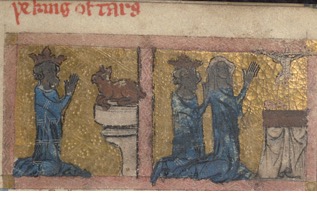
Above: A miniature at the beginning of The King of Tars in the Auchinleck manuscript (Edinburgh, National Library of Scotland, Adv MS 19.2.1, f. 7ra.), depicting the Sultan praying to an idol and then praying to Jesus after his conversion by his wife. Note the similar, embroidered robes worn by each, as well as the draped cloth on the altar (perhaps a diasper), as well as the gilded, patterned background, which may suggest a tapestry of “cloth of gold.”
So, while it may seem surprising at first that a coronation meant to reassure the English aristocracy of Edward III’s Englishness was furnished almost entirely by products of foreign manufacture, texts like The King of Tars can help clarify that such luxurious goods were not seen as contradictory to English identity. These textiles may have expressed uncertain identity in the expansive itinerary of trade they represented, but they also unequivocally spoke a language of material superiority and exoticism understood across Europe and Asia, a determination to gain the power and influence to domesticate production of such rich goods, as I discussed in my previous post.
Further evidence for the significance of foreign textiles in asserting Englishness comes from a chronicle account written in 1331, not long after Edward III’s coronation. It tells of a royal procession through London to a tournament, which, according to Sierra Lomuto, exuded a “sentiment of royal triumph . . . with the performative accoutrements of Mongol terror.”24 In her translation and interpretation of the chronicle record of the procession, Lomuto explains that “the king and other chosen knights . . . were all clothed in splendid attire and masked in the likeness of Tartars; and further, there came with them as many noble and beautiful ladies, all of whom were dressed in tunics of red velvet and capes of white camelin.”25 Lomuto argues that Edward III used “Tartar” costumes to express an enticingly “exotic” power, “a form of alterity that joins both desire and fear.”26 Once again, textiles played a central role for Edward III in asserting sovereignty, and once again, this use of foreign cloth was displayed along a route traveled through London, although this time, the connection to another culture was more explicit, clearly meant to convey the martial power of the Mongols that had been made legendary by Marco Polo. Monnas notes that her interpretation of the Feriby counter-roll affords “new insights into the physical arrangements of the medieval Coronation,” but textile lists and the romances that dramatize them also give insight into the perceived physical arrangements of the world of trade and England’s place within it during the time of Edward III.27 While the representation of clothing in Middle English literary texts has been analyzed from a number of perspectives, accounts such as that of Edward III’s coronation point toward the need to better attend to the cultural significance of the textiles that composed those clothes and the names that were used to describe them. Doing so could help clarify how the English perceived the cultural and religious “other” and how this influenced early ideas of national identity and imperial ambitions, expressed in the form of the “ultimate public record” of coronation rolls and Great Wardrobe accounts.
- Marco Polo, The Description of the World, trans. Sharon Kinoshita (Indianapolis: Hackett Publishing Company, Incorporated, 2016), 78. ↩︎
- Allsen notes that investiture practices like these were widespread across Europe and Asia, forming a kind of lingua franca of power, and they were often based on Byzantine investiture traditions, which themselves were “firmly rooted in the ancient Near Eastern / Iranian tradition.” Thomas T. Allsen, Commodity and exchange in the Mongol Empire: a cultural history of Islamic textiles (Cambridge University Press, 1997), 183. ↩︎
- Allsen, Commodity and exchange in the Mongol Empire, 1. ↩︎
- Kinoshita, ed., The Description of the World, 24. ↩︎
- Kinoshita, ed., The Description of the World, xxii ↩︎
- Filippo de Memmo, Madonna and Child with Saints and Angels, ca. 1350, tempera on wood, gold ground. ↩︎
- Polo, The Description of the World, 20. ↩︎
- Polo, The Description of the World, 20. ↩︎
- Allsen, Commodity and Exchange, 3. ↩︎
- Kinoshita, ed.,The Description of the World, 63. ↩︎
- Lisa Monnas, “Textiles for the Coronation of Edward III,” Textile history 32, no. 1 (2001): 5. ↩︎
- Maria Ludovica Rosati, “Panni tartarici: Fortune, Use, and the Cultural Reception of Oriental Silks in the Thirteenth and Fourteenth-century European Mindset,” In Seri-Technics: Historical Silk Technologies, ed. Dagmar Schäfer, Giorgio Riello, and Luca Molà (Berlin: Max Planck Research Library for the History and Development of Knowledge, 2020), 81. ↩︎
- Christopher Dawson, ed., The Mongol Mission: Narratives and Letters of the Franciscan Missionaries in Mongolia and China in the thirteenth and fourteenth centuries (London: Sheed and Ward, 1955), xxi. ↩︎
- Notably, while the Feriby account only uses the term Tars’ in its list of purchases, it does include two mentions of the term pann’ tartar’ in its later description of how the textiles were used during the ceremony.This suggests either that panni de Tars’ and pann’ tartar’ were interchangeable terms, or that pann tartar’ references a distinct kind of cloth purchased on a different occasion. The National Archives of the UK: E 101/383/6. ↩︎
- E. Jane Burns, Courtly love undressed: reading through clothes in medieval French culture (University of Pennsylvania Press, 2002), 187. ↩︎
- Bart Lambert and Milan Pajic, “Drapery in Exile,” History 99, no. 338 (2014): 733, . ↩︎
- Anne Laskaya and Eve Salisbury, eds., The Middle English Breton Lays (Kalamazoo: Western Michigan University, 1995), 156. ↩︎
- Siobhain Bly Calkin, “Marking Religion on the Body: Saracens, Categorization, and ‘The King of Tars’,” The Journal of English and Germanic Philology 104, no. 2 (2005): 236. ↩︎
- Calkin, “Marking Religion on the Body,” 224. ↩︎
- Is she from Tarsus, in Lesser Armenia, and therefore within the fold of European Christendom? Or is she, as Sierra Lomuto suggests, a Mongol princess of “Tartary” who represents the European hope that the Mongols would convert to Christianity and ally with them against Muslims? ↩︎
- Anonymous, “The King of Tars,” trans. Blake Hahn, Global Medieval Sourcebook: 380-382, accessed April 14, 2025. ↩︎
- Calkin, “Marking Religion on the Body,” 224. ↩︎
- Calkin, “Marking Religion on the Body,” 238. ↩︎
- Sierra Lomuto, “The Mongol Princess of Tars: Global Relations and Racial Formation in The King of Tars (c. 1330),” Exemplaria 31, no. 3 (2019): 171. ↩︎
- Lomuto, “The Mongol Princess of Tars,” 172. ↩︎
- Lomuto, “The Mongol Princess of Tars,” 174. ↩︎
- Monnas, “Textiles for the Coronation of Edward III,” 20. ↩︎
 Listology
Leave a comment